
I was absolutely the target audience for this movie. Especially since I’m an OG UFC and PRIDE Fighting Championships fan. I was there during the wild, largely unregulated days of mixed martial arts in the 1990s and early 2000s, long before the UFC became the multibillion-dollar spectacle it is today.
So naturally, I was already familiar with the legend of Mark Kerr. I witnessed his rise. And I witnessed his fall. Hell, I even watched the excellent 2002 documentary The Smashing Machine: The Life and Times of Extreme Fighter Mark Kerr, directed by John Hyams, which serves as the foundation for this film.
Written, directed, and edited by Benny Safdie, The Smashing Machine attempts to recreate the turbulent life of an accomplished collegiate wrestler who became one of the most feared fighters during MMA’s formative years. Mark Kerr was a physical specimen, a dominant force in a sport that was still figuring out its own identity. But behind the imposing physique and terrifying reputation was a deeply troubled man.
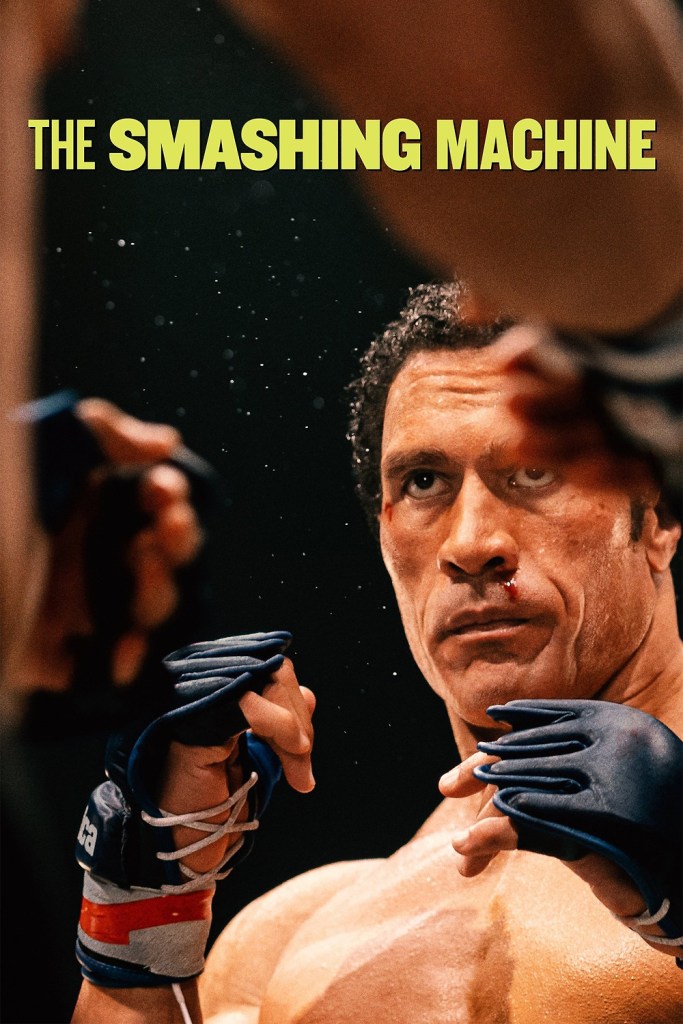
Dwayne Johnson plays Kerr as he navigates the pressures of professional fighting, a growing addiction to painkillers, the psychological consequences of losing, and an increasingly volatile relationship with his girlfriend, Dawn (Emily Blunt). And that’s where the film finds its greatest strength—the performances.
Dwayne Johnson delivers what is arguably the finest dramatic performance of his career. The prosthetic makeup certainly helps him disappear into the character, but it’s his willingness to embrace Kerr’s vulnerability that makes the performance work. The Rock is playing a man who has built his entire identity around being unbeatable, only to discover that losing inside the ring is considerably easier to accept than losing control of his own life. There’s something genuinely fascinating about watching this physically imposing man become so emotionally fragile.
Emily Blunt is equally impressive as Dawn, a former Playboy model whose relationship with Kerr becomes one of the film’s most destructive elements. She wants to be his emotional anchor, but her own insecurities and volatile behavior repeatedly undermine that responsibility. Their relationship is exhausting. Blunt captures that dysfunction remarkably well, delivering one of her strongest performances in recent years.
The decision to cast former UFC fighter Ryan Bader as legendary MMA pioneer Mark Coleman was an interesting one. Bader certainly looks the part, and there’s an authenticity to having an actual professional fighter portray one of the sport’s most important figures. However, I couldn’t help thinking that a more seasoned dramatic actor might have brought additional emotional weight to some of those pivotal scenes.
The opening sequence is outstanding. It immediately establishes Kerr’s intimidating presence, the brutality of early MMA, in a sport that was still considered barbaric by much of the mainstream public. I wish the rest of the film had maintained that same energy. Because one of my biggest frustrations with The Smashing Machine is how little time it spends establishing just how dominant Mark Kerr actually was — and that dominance is essential to appreciating the magnitude of his eventual decline.
The recreation of PRIDE Fighting Championship is remarkably well executed. For those unfamiliar with the sport’s history, PRIDE wasn’t simply another MMA promotion. During its peak, it was arguably the most spectacular fighting organization on the planet. The enormous Japanese arenas, theatrical, Pro Wrestling style entrances, larger-than-life personalities, and extraordinary international fighters made it something completely different from the UFC.
But I also wish the film had explored more of the questionable business practices and alleged corruption surrounding the organization. That darker side of PRIDE is an important part of MMA history, and it could have added another layer to the pressures these fighters were experiencing. Kerr’s addiction and rehabilitation was another missed opportunity.
The film establishes his drug dependency and the damage it’s causing, but his time in rehab comes and goes surprisingly quickly. Considering how central addiction was to Kerr’s personal destruction, I wanted the film to spend considerably more time exploring that struggle.
There’s an extraordinary character study buried in there. Unfortunately, the film only scratches the surface. And perhaps that’s my biggest disappointment. Having already watched the original documentary, I knew how disturbing, intimate, and emotionally devastating this story could be. Which is particularly frustrating because the ingredients were all there. An extraordinary true story. Two outstanding lead performances. A fascinating period in combat sports history. And a filmmaker who clearly understands how to portray deeply flawed people living on the edge of self-destruction.
Even with Dwayne Johnson’s considerable star power, The Smashing Machine struggled commercially, and bombed at the box office. Perhaps audiences weren’t interested in watching The Rock play such a vulnerable, emotionally damaged character. Or perhaps the film simply never found an audience beyond hardcore MMA enthusiasts. Whatever the reason, there’s an entertaining film here. And a story worth watching.
THE SMASHING MACHINE (2025). THREE OUT OF FIVE POPCORN BAGS 🍿🍿🍿