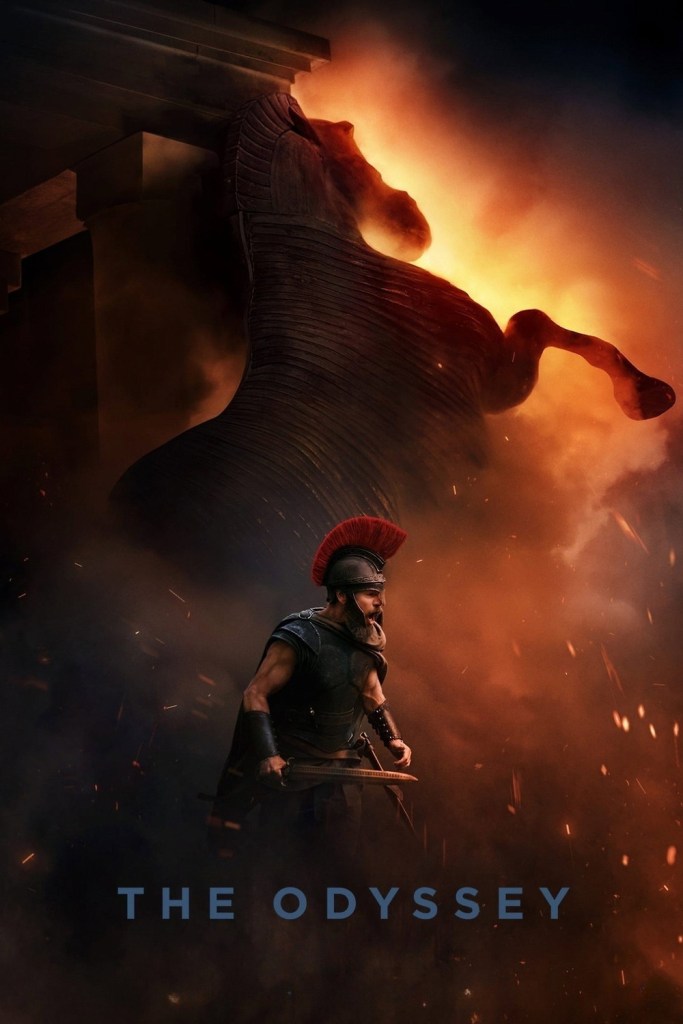

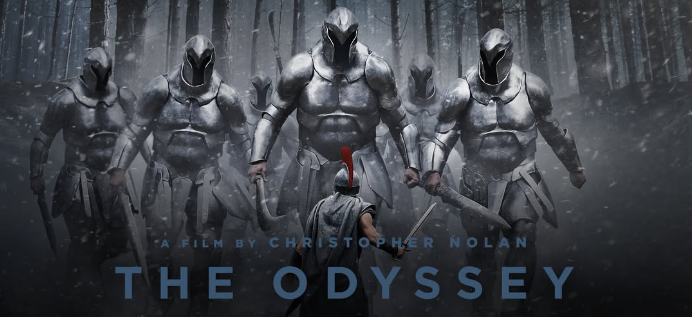
The summer blockbuster season is officially back. When I went to see The Odyssey in IMAX, I was genuinely surprised by how packed the theater was. Multiple showings, nearly every one of them sold out. It felt like going to the movies in the 90s, and early 2000s again.
Between The Odyssey, Spider-Man: Brand New Day, The Mandalorian & Grogu, Toy Story 5, Masters of the Universe, Obsession, Michael, and Project Hail Mary, theaters are finally seeing the kind of crowds they haven’t experienced since before the pandemic. For the first time in years, it feels like the moviegoing experience is becoming an event again.
And The Odyssey absolutely deserves to be seen on the biggest screen possible. Christopher Nolan doesn’t tell this story in a linear fashion. Instead, he interweaves three separate narratives that gradually collide. Back in Ithaca, Penelope (Anne Hathaway) struggles to keep ambitious suitors from claiming both her hand in marriage and the throne of Ithaca. Her son, Telemachus (Tom Holland), refuses to believe his father is dead, clinging to the hope that Odysseus will eventually find his way home.
Meanwhile, Odysseus (Matt Damon) has been away for twenty years. We have an older Odysseus, suffering from memory loss, living on an island with Calypso (Charlize Theron). Which is ironic, considering Damon is once again playing a legendary warrior with no memory of his past (Bourne series). From there, the story jumps back to younger Odysseus and the aftermath of the Trojan War, following the long and increasingly disastrous voyage home. His pride repeatedly sabotages him, clouds his judgment, and one poor decision after another slowly erodes the loyalty of the men following him.
The first act takes its time. There are moments where the pacing feels a little uneven, and the film probably could have benefited from trimming a few scenes here and there. But once the emotional threads begin weaving together, those concerns largely disappear. Nolan places greater emphasis on Penelope and Telemachus than many previous adaptations, while compressing or omitting portions of Odysseus’s journey from the original source material. The result feels less like a straightforward adventure and more like a story about family, love, grief. absence, and the passage of time.
Visually, the film is astonishing. Hoyte van Hoytema once again proves why he’s one of the greatest cinematographers working today. Every frame feels monumental. The sequence inside the Trojan Horse is particularly masterful—tense, claustrophobic, and brilliantly staged. One detail I particularly appreciated was the dialogue. Rather than relying on the familiar tradition of giving a British accent to historical characters, Nolan allows his cast to speak in contemporary American English, and use modern American English words.
The horror element is prominent and effective here. The Witch Circe (Samantha Morton) feels like she wandered in from a horror film you find on Shudder. The transformation of Odysseus’s men into pigs is genuinely disturbing. The Cyclops sequences are spectacular, with impeccable motion-capture work that gives the creature incredible physical presence. The Laestrygonians—the man-eating giants, are every bit as terrifying,
The supporting cast is exceptional. John Leguizamo delivers one of the strongest performances of his career as Eumaeus. Robert Pattinson is wonderfully slimy as the film’s primary antagonist, similar to how fantastically villainous he was in The King (2019). John Bernthal brings surprising emotional weight as Menelaus, showing that the trauma of the Trojan War continues to haunt its survivors long after the fighting ended. Even Benny Safdie, whose face remains largely concealed as Agamemnon, commands the screen through sheer presence alone.
In many ways, The Odyssey belongs alongside the great sword-and-sandal classics like Ben-Hur, Spartacus, and Cleopatra. It also earns its place among the modern epics of the ancient world—films like Gladiator (2000), Troy (2004), and Kingdom of Heaven (Director’s Cut, 2005)—stories built around legendary battles, fallen empires, and mythic heroes.
Yet it never feels trapped by that tradition. Nolan finds a fresh way into one of humanity’s oldest stories, balancing spectacle with something surprisingly intimate. Heavily influenced by Emily Wilson’s acclaimed translation of The Odyssey, Nolan has crafted another ambitious, deeply cinematic experience. This feels like a film that requires multiple viewings.
THE ODYSSEY (2026). FOUR OUT OF FIVE POPCORN BAGS🍿🍿🍿🍿