
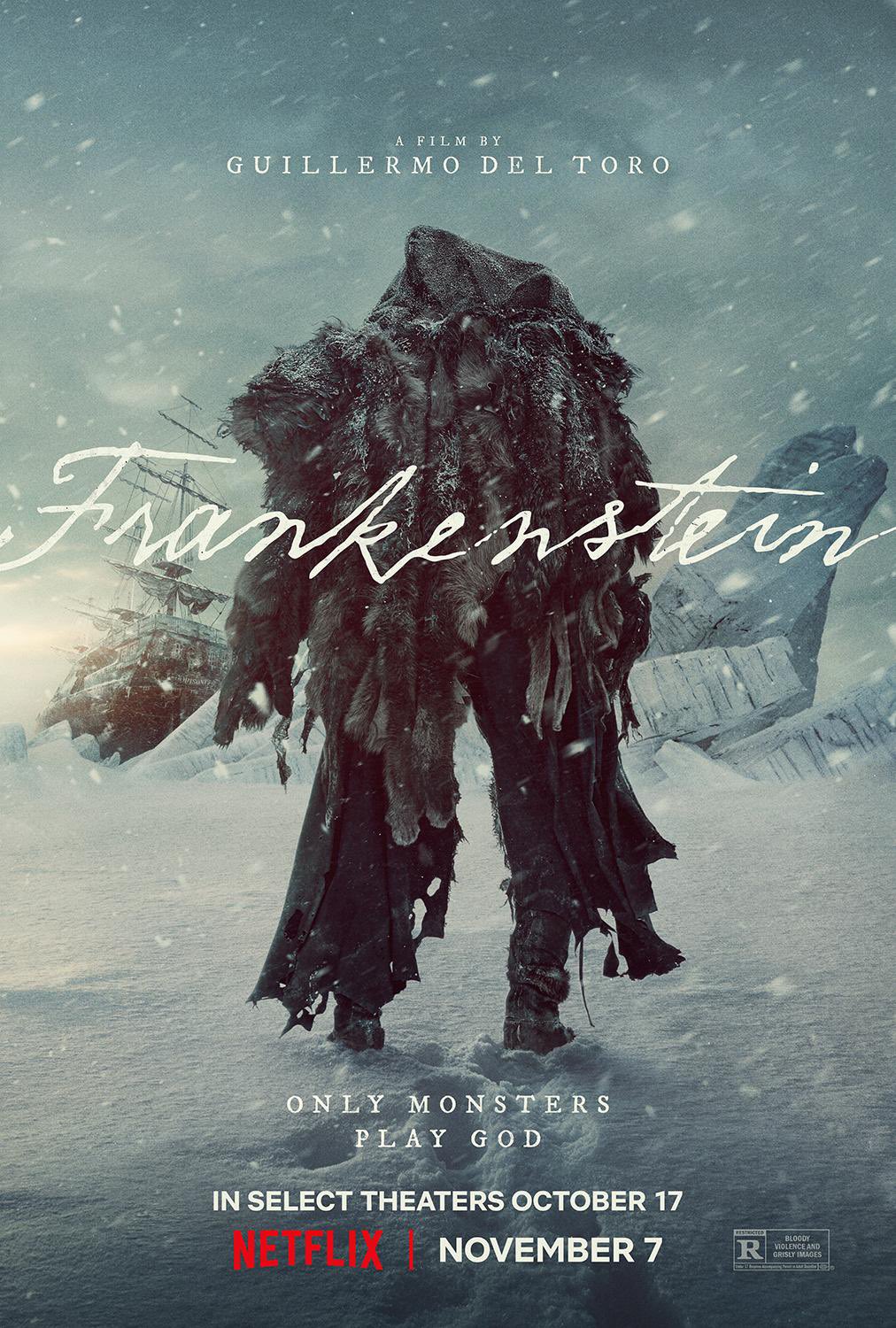
Everyone knows the story of Mary Shelley’s Frankenstein. Or at least the outline of it. A man plays God. Creates life. Regrets it. Abandons it
But there’s something strangely fitting about watching this story get resurrected again. Mary Shelley’s story has survived countless reinterpretations, but this one feels different — like a reckoning. A quiet confrontation with the things we keep creating in our own image, and the consequences we’re still not ready to face. Especially now, in a world moving faster than it can understand itself.
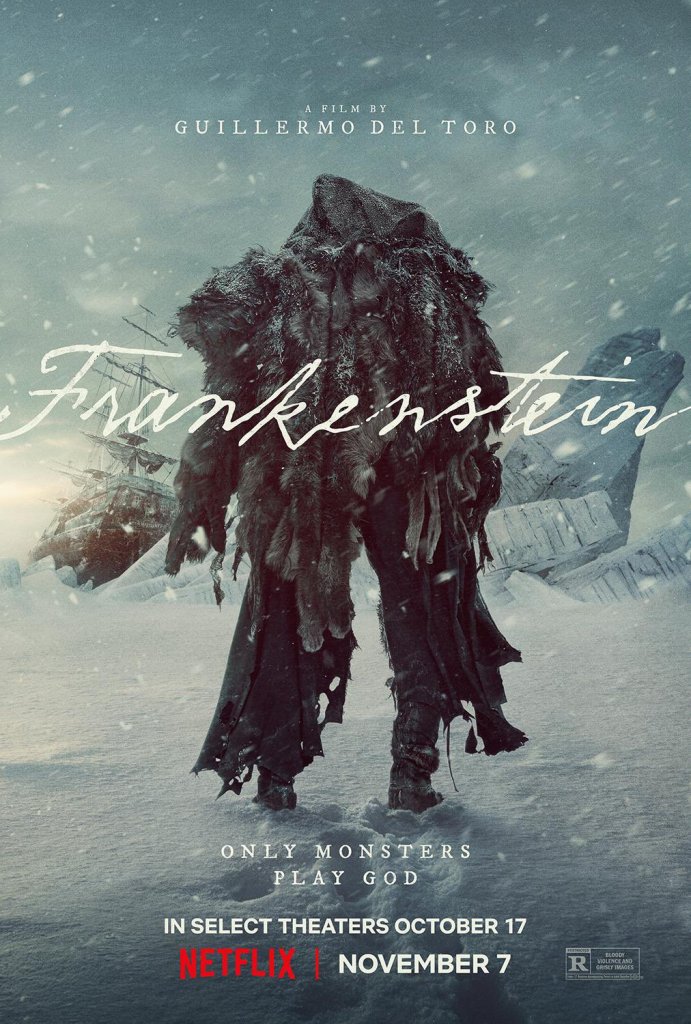
This is Guillermo del Toro’s Frankenstein. And while it takes liberties with Shelley’s original text, it stays true to the tone —while layering in something deeply personal. Something unmistakably his. Some characters are gone. Others are new. But the core remains.
The tension between creator and creation. It’s always been there in Del Toro’s work — Cronos, Hellboy, Blade II. That fascination with monsters who feel more human than the people who made them. His perspective — shaped by his Hispanic, and Catholic upbringing, gives the mythology of this story a different weight.
This version is told in two parts. First, Victor. Then, the creature.
After the death of his mother, Victor Frankenstein (Oscar Isaac) becomes consumed with the idea of conquering death. He’s raised under the shadow of an abusive father, Baron Leopold Frankenstein (Charles Dance), and that damage runs deep. It bleeds into everything. His need for control. His detachment. His inability to understand the life he’s trying to create. Isaac plays him as a brilliant, but hollowed out scientist. A man convinced he’s chasing something noble. And when he finally succeeds in creating life — he abandons it immediately. Like it disgusts him—leaving it behind to die. As a result, the creature is hellbent on revenge.
That’s where the story shifts. Because The Creature (Jacob Elordi) isn’t what you expect. He’s not driven purely by revenge. He’s searching for something meaningful. For a connection that resembles love. Elordi’s performance is physical, but also deeply emotional. There’s something childlike in the beginning — confusion, vulnerability that slowly hardens into something more complicated. Still, at the very core, he is driven mad by his creator’s abandonment.
The supporting cast holds everything together. Christoph Waltz, as Heinrich Harlander, brings a grounded, almost calculating presence — anchoring the story in the realities of power and economics. The Blind Man, played by the always wonderful David Bradley, becomes the one place where the creature begins to discover something resembling humanity.
Mia Goth, in a dual role, adds another layer of emotional tension, especially within the strange, overlapping relationships orbiting Elizabeth. Her engagement to William Frankenstein (Felix Kammerer), while being romantically pursued by Victor adds an important layer of tension to the story.
And visually, the film is stunning. Del Toro leans fully into the gothic. Originally, the story wasn’t set in Victorian England, but Del Toro reimagines it within a gothic Victorian world. Rich, deliberate colors, Victorian textures. Every frame feels constructed in detail. There’s blood, yes. There’s violence. But it never plays like horror for the sake of horror. Outstanding cinematography by Dan Laustsen.
Frankenstein 2025 is a monster story with weight, and consequence. The creature isn’t the horror here—he is heartbroken, lonely and in need of love. It departs a bit from the original story where the creature is far more vengeful. There is a redemptive arc here. It’s a movie about what happens after creation has gone wrong. About what it means to walk away from something you made… and the damage that leaves behind. It is also about atonement and forgiveness. And by the end, you’re left with a slow, uncomfortable realization that the monster was never the problem. It was the maker….and it still is.
FOUR OUT OF FIVE POPCORN BAGS 🍿🍿🍿🍿
FRANKENSTEIN (2025)

 Rod Rioja