

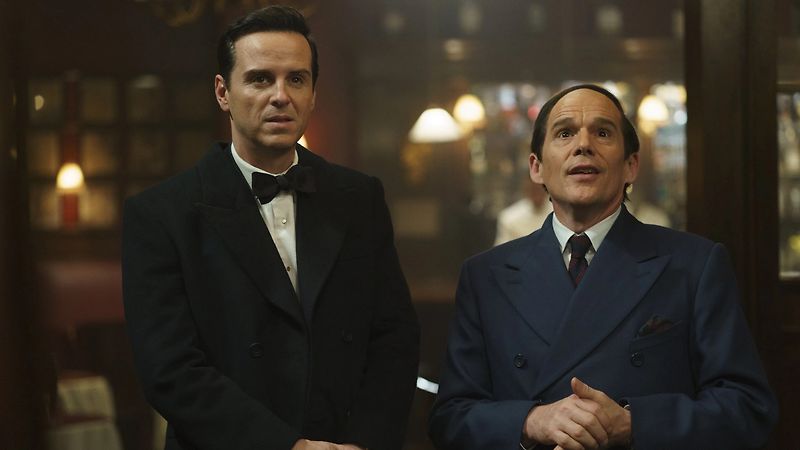
These last few weeks I’ve been on a frantic marathon run to watch all the Academy Award–nominated films ahead of the Oscars ceremony. Racing through the list of nominees in a short window has become a fun annual ritual for me. Thankfully, Netflix, Hulu, Peacock, and HBO have most of them available to stream, so I’ve been able to make a solid dent in the watch list.
Blue Moon takes place in 1943 at the legendary Sardi’s restaurant in New York City, unfolding over the course of one single infamous night during the after-party for the Broadway opening of Oklahoma!.
The story centers around the famous lyricist, and composer Lorenz Hart (Ethan Hawke) and the quiet collapse of his late career. Hart’s longtime creative partner, Richard Rodgers (Andrew Scott), has just joined forces with Oscar Hammerstein (Simon Delaney) for the first time to produce Oklahoma! — a project Hart himself declined to participate in. Rodgers and Hart were once a formidable duo. But by this point their partnership had run its course. History would later show that the Rodgers and Hammerstein collaboration would go on to eclipse much of the earlier work Rodgers had created with Hart.

Despite the compressed timeframe of a single evening, the film slowly unpacks the history and emotional lives of its characters, particularly Hart’s. The narrative is stitched together through firsthand reports and personal letters exchanged between Hart and Elizabeth Weiland (Margaret Qualley).
Elizabeth Weiland is loosely inspired by a real person who corresponded with Hart through letters. In the film she is portrayed as a young college student with aspirations of becoming a production designer. She is also the object of Hart’s intense fascination. Despite his apparent sexual orientation, Hart becomes determined to win her affection at almost any cost. His obsession with Elizabeth is uncomfortable to watch at times. She clearly does not share his romantic interest and seems to view him more as a mentor than anything else. That imbalance creates some of the film’s most quietly painful moments.
Ethan Hawke delivers an exceptional performance here. He captures Hart as a man with very little self-awareness — the loudest, most obnoxious presence in the room, always performing, always deflecting. His alcoholism has clearly taken a toll on both his reputation and his work. In reality, Lorenz Hart was famously diminutive in stature, so the film uses subtle camera tricks to make Hawke appear shorter than the rest of the cast. It’s a small technical detail, but one that helps reinforce the physical and psychological vulnerability of the character.
The rest of the cast is equally strong. Bobby Cannavale is excellent as the bartender, quietly attempting to manage Hart’s heavy drinking throughout the night. One of my favorite moments comes during the scenes with legendary writer E.B. White (Patrick Kennedy), particularly the moment where Hart inadvertently plants the seed of inspiration that would eventually become Stuart Little.
The opening scene is especially clever. From the very beginning, you get the sense of where this character’s story is heading, which adds an extra layer of melancholy to everything that follows. Director Richard Linklater continues his quiet streak of thoughtful, introspective films. This one also marks the ninth collaboration between Linklater and Ethan Hawke — a creative partnership that has aged gracefully over the years, producing some of the most reflective character studies in modern cinema.
In the end, Blue Moon feels like a film that rewards multiple viewings. It’s a dialogue-driven story about the strange, fragile process of creating art — but underneath that, it’s really a story about loneliness, jealousy, fading relevance, and the quiet sadness that sometimes follows genius.
A small film in scale, but one that lingers long after the final scene.
BLUE MOON (2025). FOUR out of FIVE Popcorn Bags🍿🍿🍿🍿


 Rod Rioja